
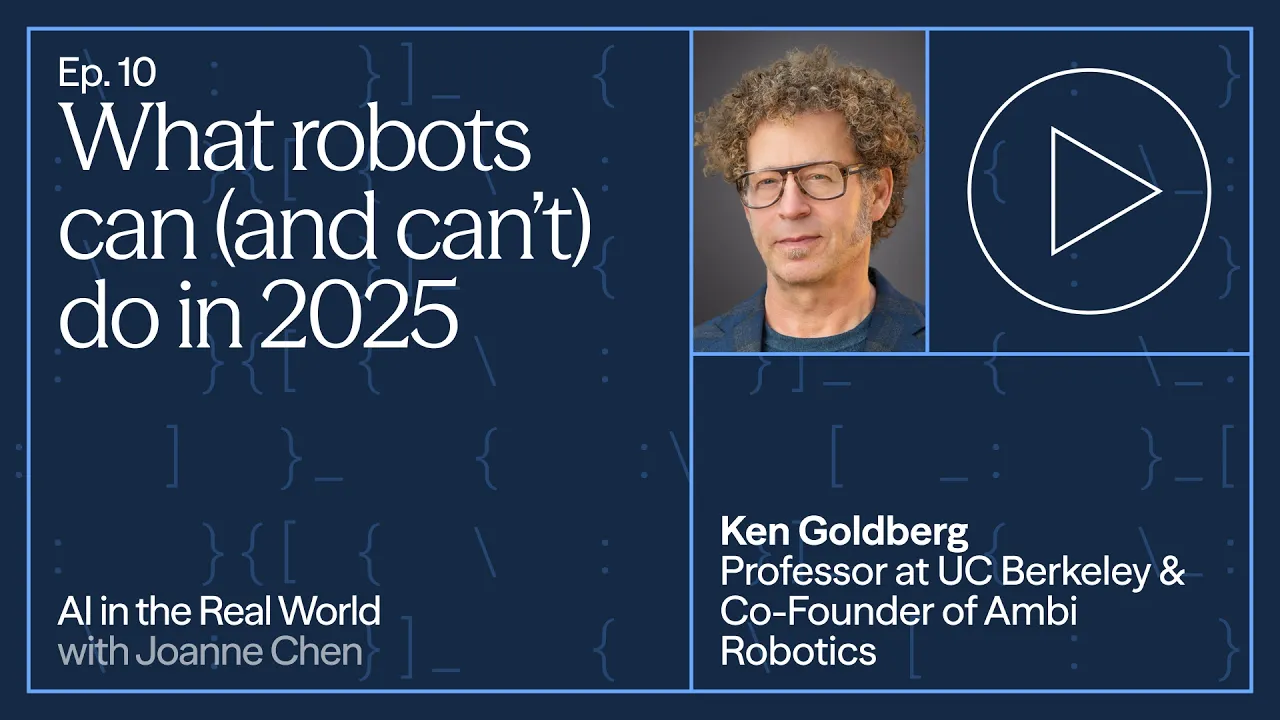
What robots can (and can’t) do in 2025

Posted

Aug 29, 2025

0 MIN READ
0 MIN READ

Show Outline

Ken Goldberg is a professor of engineering at UC Berkeley and the co-founder of Ambi Robotics, a company applying AI-enabled robotics to the logistics industry. Ken has spent over four decades working on one of the hardest problems in robotics: how machines perceive and manipulate the physical world. We spoke about why tasks that seem effortless to humans - like picking up a glass or folding laundry - are still incredibly difficult for robots.

Our conversation also covers:

  • What it would take to reach a “ChatGPT moment” in robotics

  • Why simulation data isn't enough without real-world grounding

  • And why the next decade of robotics depends on combining cutting-edge models with good old-fashioned engineering

Chapters:

  • 00:00 Cold open: Why robotics still needs good old-fashioned engineering

  • 03:46 Hype cycles and winters in robotics

  • 05:08 Why folding laundry is still hard for robots

  • 10:38 What robots are good at today

  • 15:00 Automation and the rise of warehouse robotics

  • 19:39 Can LLMs and generative AI work for robotics?

  • 26:52 The limits of simulation data and the sim-to-real gap

  • 29:44 Why humanoids are still far from practical

  • 36:34 What founders need to know about robotics timelines

  • 37:08 Why robots need grounding and exploration

  • 39:00 Combining the power of LLMs with traditional engineering

  • 40:42 Why Ken is optimistic about the future of robotics

Get insights directly to your inbox.

Set your newsletter preferences:

Set your newsletter preferences:

Posted

Aug 29, 2025

0 MIN READ

Show Outline

Ken Goldberg is a professor of engineering at UC Berkeley and the co-founder of Ambi Robotics, a company applying AI-enabled robotics to the logistics industry. Ken has spent over four decades working on one of the hardest problems in robotics: how machines perceive and manipulate the physical world. We spoke about why tasks that seem effortless to humans - like picking up a glass or folding laundry - are still incredibly difficult for robots.

Our conversation also covers:

  • What it would take to reach a “ChatGPT moment” in robotics

  • Why simulation data isn't enough without real-world grounding

  • And why the next decade of robotics depends on combining cutting-edge models with good old-fashioned engineering

Chapters:

  • 00:00 Cold open: Why robotics still needs good old-fashioned engineering

  • 03:46 Hype cycles and winters in robotics

  • 05:08 Why folding laundry is still hard for robots

  • 10:38 What robots are good at today

  • 15:00 Automation and the rise of warehouse robotics

  • 19:39 Can LLMs and generative AI work for robotics?

  • 26:52 The limits of simulation data and the sim-to-real gap

  • 29:44 Why humanoids are still far from practical

  • 36:34 What founders need to know about robotics timelines

  • 37:08 Why robots need grounding and exploration

  • 39:00 Combining the power of LLMs with traditional engineering

  • 40:42 Why Ken is optimistic about the future of robotics

Get insights directly to your inbox.

Set your newsletter preferences:

Get insights directly to your inbox.

Set your newsletter preferences:

Set your newsletter preferences: